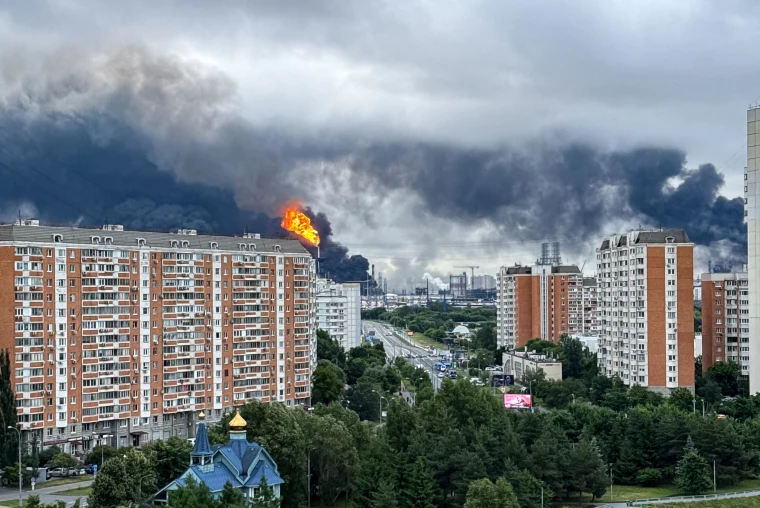
KYIV — A sprawling refinery complex on the southern outskirts of Moscow was set ablaze early Thursday in what residents described as the most violent series of explosions to shake the Russian capital since the start of the war. Ukrainian military intelligence claimed responsibility within hours, calling the strike "a precise demilitarization of an energy node that fuels the aggressor's war machine."
Open-source analysts geolocated columns of black smoke and a sustained ground fire to a fuel-processing complex inside the Moscow Ring Road, marking the deepest publicly acknowledged Ukrainian long-range strike of the conflict. Russian Telegram channels reported at least nine separate detonations between 3:42 and 4:11 a.m. local time.
What Was Hit
Imagery analyzed by independent monitoring group Conflict Intelligence Team appears to show damage to at least two atmospheric distillation units, a hydrocracker, and a cluster of storage tanks. Initial estimates suggest between 180,000 and 240,000 barrels per day of refining capacity may be offline for weeks.
An Escalating Long-Range Campaign
Thursday's attack fits a pattern that has intensified steadily over the past nine months. Ukrainian-built long-range strike drones — including new domestically produced jet-powered variants reportedly capable of cruising beyond 1,000 kilometers — have hit refineries, ammunition depots and command nodes across western Russia.
Western intelligence officials estimate that Ukraine has degraded between 14 and 17 percent of Russia's primary refining capacity since last autumn, contributing to chronic fuel shortages in southern Russia and forcing the Kremlin to extend a partial export ban on gasoline.
“The center of gravity of this war has shifted from the front line to Russia's industrial interior. Kyiv has decided that energy infrastructure is a legitimate and decisive target.”
Russian Response
The Russian Defense Ministry acknowledged the attack but described it as a "failed terrorist sortie" and claimed its air-defense units had intercepted the majority of the incoming drones. Independent video evidence and the visible damage suggest a more mixed picture.
Moscow Mayor Sergei Sobyanin urged residents in the city's southern districts to keep their windows closed and to avoid the area around the refinery for at least 48 hours. Several primary schools in the affected neighborhoods canceled classes Thursday.
Battlefield Implications
Military analysts say the broader significance of the strike lies less in the immediate damage than in what it signals about Ukraine's industrial and operational maturation. Two years ago, Ukrainian drones could reach Moscow only sporadically; today they can do so in tight, coordinated waves designed to overwhelm urban air defenses.
"The economics here favor Kyiv," said Samuel Bendett, an adviser at the Center for a New American Security. "A long-range strike drone costs perhaps $200,000 to $400,000 to produce. The interceptor missiles Russia is burning to shoot them down cost two to ten times more, and they cannot be produced as quickly."
Escalation Concerns
Western governments have offered measured responses. A spokesperson for the U.S. State Department said only that Washington "does not direct or encourage strikes inside Russia," while declining to condemn the operation. Germany and the United Kingdom both said the war's continuation was a consequence of Russia's refusal to engage in serious negotiations.
The Kremlin has historically threatened severe retaliation for attacks on the capital, but its options are constrained. Conventional strikes on Kyiv have continued for years without changing the strategic calculus, and any non-conventional escalation would carry enormous risk.
The Future Battlefield
Thursday's strike is likely to accelerate trends already reshaping modern warfare. Long-range, mass-produced drones — cheap, autonomous, and increasingly capable of evading layered air defenses — are eroding the traditional protection that geographic depth has provided to industrial economies at war.
For Kyiv, the campaign is also about messaging. By striking inside the Moscow Ring Road, Ukraine is signaling to its Western partners that it can impose costs on Russia's heartland with weapons it builds itself — a politically useful argument as debates over Western military aid continue in Washington and several European capitals.
Whether the strike alters the trajectory of the war remains to be seen. What is no longer in doubt is that the front line, in any meaningful sense, now runs through the suburbs of Russia's capital.