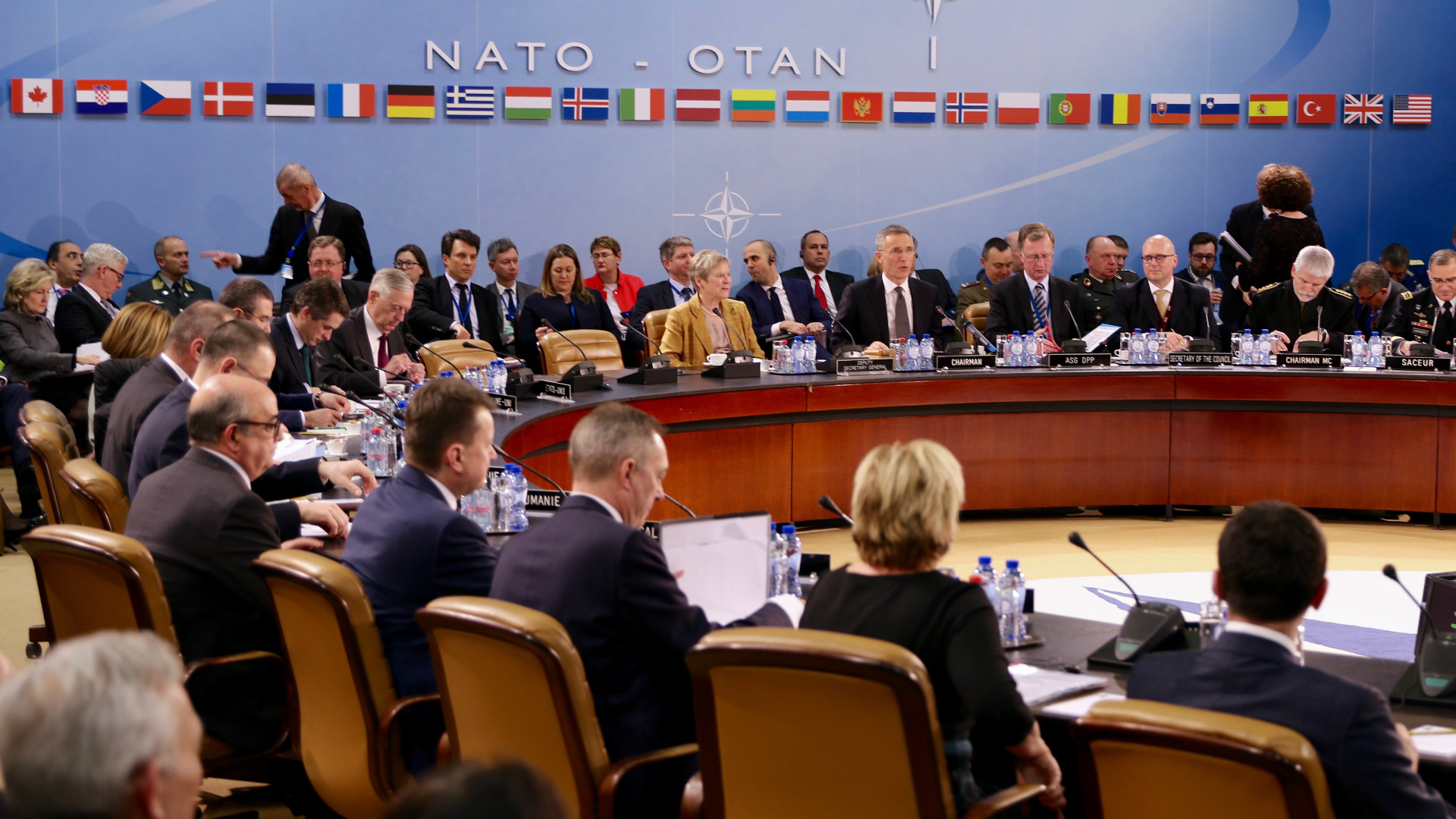
BRUSSELS — A Pentagon force-posture review submitted to the White House late last week has reopened the most consequential debate within NATO since the alliance's enlargement decisions of the early 2000s: how large, how forward, and how American should the alliance's conventional posture remain?
The classified review, portions of which have been described to allies in closed-door briefings, recommends a measured reduction of roughly 12,000 U.S. personnel from Europe over the next 24 months, paired with an increase in rotational deployments and a renegotiation of basing arrangements in Germany, Poland and Romania.
A Carefully Worded Reassurance
Defense Secretary Pete Hegseth told NATO defense ministers Thursday that the United States "remains committed to Article 5 and to the defense of every inch of allied territory." But he also signaled, more directly than at any previous meeting, that Washington expects European members to assume primary responsibility for conventional deterrence on the continent.
Several European officials emerged from the meeting describing the U.S. position as "clarifying rather than alarming," though privately a number conceded that it accelerates planning assumptions they had hoped to defer.
Defense Spending: The Center of Gravity Shifts
European defense budgets have grown substantially since 2022, and 23 of NATO's 32 members are now at or above the alliance's two-percent-of-GDP spending target. But the conversation has quietly shifted to a new benchmark — three percent — that several front-line states already meet and that Washington is encouraging others to adopt.
Poland, which now spends more than 4.4 percent of GDP on defense, has positioned itself as the model the alliance's eastern flank is converging toward. Germany, by contrast, has reached two percent largely through one-time fund disbursements that will need to be replaced by structural budget increases later this decade.
“If Europeans want a different kind of American presence, they need to demonstrate that they can carry the conventional load. Europe is not there yet, but it is closer than it has been in a generation.”
Front-line Anxieties
The reaction in eastern Europe has been markedly less sanguine than in Brussels. Estonian Defense Minister Hanno Pevkur said that any reduction "must be accompanied by an unambiguous demonstration of continued American commitment, including pre-positioned equipment and visible rotational deployments." Poland's defense ministry called the review's conclusions "acceptable in principle, conditional in execution."
Lithuanian officials have privately accelerated planning for additional German brigade deployments to their territory, while Romanian counterparts are pressing for an enlargement of the Aegis Ashore site at Deveselu and a permanent rather than rotational U.S. brigade footprint at Mihail Kogălniceanu Air Base.
Readiness and Modernization Gaps
Beyond personnel numbers, NATO planners have spent the past year stress-testing whether European militaries can sustain high-intensity operations without immediate U.S. enablers. The honest answers, embedded in the alliance's most recent capability reviews, point to persistent shortfalls in long-range fires, integrated air and missile defense, strategic airlift and electronic warfare.
France and the United Kingdom have begun to fill some of those gaps through bilateral arrangements, including a recently signed accord to integrate French and British nuclear planning at unprecedented depth. Germany's procurement of Israeli-designed Arrow 3 interceptors will, when fully operational, provide a strategic-tier missile defense capability the continent has lacked.
Allied Strategy in Flux
The strategic conversation inside the alliance has begun to shift from whether to maintain the post-Cold War American-led model to how to evolve it. Some European officials, particularly in Paris, see the U.S. review as a long-overdue catalyst. Others worry that the politics on both sides of the Atlantic are moving faster than the institutions can adapt.
NATO Secretary General Mark Rutte struck a careful balance in his post-meeting remarks, describing the review as "part of a normal and necessary conversation about adaptation." He emphasized that the alliance's defense plans, agreed at last year's Washington summit, remain the operative blueprint.
What Comes Next
Allied capitals will spend the summer translating the review's broad direction into concrete plans for the Vilnius defense ministerial in October. Key decisions will include the future of the U.S. V Corps forward headquarters in Poznań, the disposition of two Stryker brigades currently rotating through Eastern Europe, and the long-term basing of U.S. air assets at Ramstein and Spangdahlem.
Whatever emerges, the era in which European defense plans could assume a static American footprint is closing. NATO is not unraveling — but it is, unmistakably, being rebuilt.